Hamstad BM5
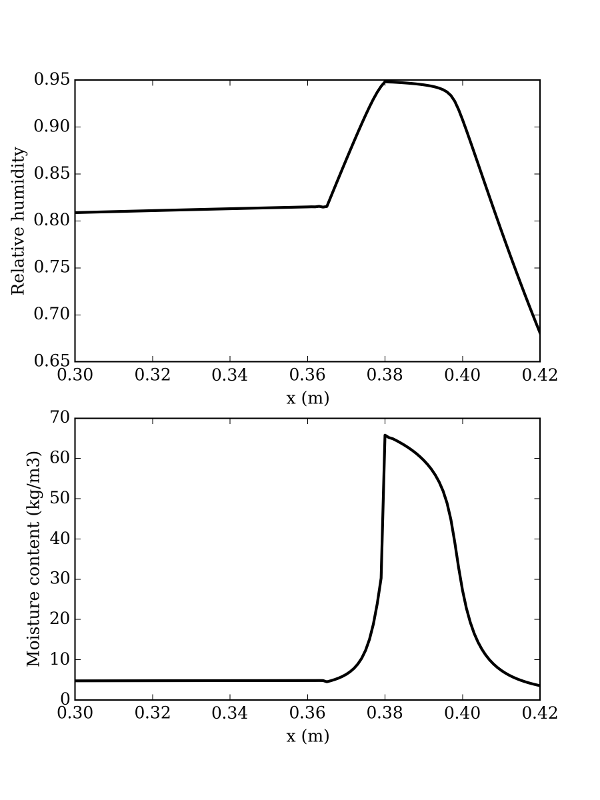
This script simulates the fifth exercise of the Hamstad benchmark package: multi-layered wall with capillary active inside insulation
Since hamopy is not really speed-optimised, this may take a few minutes to compute.
Script
"""
5th exercise of the Hamstad benchmark package

Capillary active inside insulation
"""

from hamopy.classes import Mesh, Boundary, Time

# Choice of materials and geometry
from hamopy.materials.hamstad import BM5_brick, BM5_mortar, BM5_insulation

mesh = Mesh(**{"materials"    : [BM5_brick, BM5_mortar, BM5_insulation],
           "sizes"        : [0.365, 0.015, 0.040],
           "nbr_elements" : [100, 20, 20] })

# Boundary conditions
clim1 = Boundary('Fourier',**{"T"   : 273.15,
                          "HR"  : 0.8,
                          "h_t" : 25.,
                          "h_m" : 1.8382e-7 })

clim2 = Boundary('Fourier',**{"T"   : 293.15,
                          "HR"  : 0.6,
                          "h_t" : 8.,
                          "h_m" : 5.8823e-8 })

clim = [clim1, clim2]

# Initial conditions
init = {'T'  : 298.15,
    'HR' : 0.6}

# Time step size
time = Time('variable',**{"delta_t"  : 900,
                      "t_max"    : 12960000,
                      "iter_max" : 12,
                      "delta_min": 1e-3,
                      "delta_max": 900 } )

if __name__ == "__main__":

    import numpy as np

    # Calculation
    from hamopy.algorithm import calcul
    result = calcul(mesh, clim, init, time)

    # Post processing
    from hamopy.postpro import distribution

    t_plot = 12960000
    x_plot = np.linspace(0, 0.42, 421)

    from hamopy import ham_library as ham

    Temperature = distribution(result, 'T', x_plot, t_plot)
    Humidity    = distribution(result, 'HR', x_plot, t_plot)
    Moisture    = np.zeros(np.shape(Temperature))

    # Moisture content distribution of each layer
    for i in range(len(mesh.materials)):
    xmin = sum(mesh.sizes[0:i])
    xmax = sum(mesh.sizes[0:i+1])
    mask = ((x_plot >= xmin) & (x_plot <= xmax))
    Moisture[mask] = mesh.materials[i].w(ham.p_c(Humidity[mask],Temperature[mask]), Temperature[mask])

    # Plotting results

    import matplotlib.pylab as plt
    from matplotlib import rc
    rc("font", family="serif", size=12)

    figsize(6, 8)

    ax = plt.subplot(211)

    plt.plot(x_plot[300:], Humidity[300:], 'k-', linewidth=2)
    plt.xlabel('x (m)')
    plt.ylabel('Relative humidity')

    ax = plt.subplot(212)

    plt.plot(x_plot[300:], Moisture[300:], 'k-', linewidth=2)
    plt.xlabel('x (m)')
    plt.ylabel('Moisture content (kg/m3)')

    fig = plt.gcf()
    fig.savefig('BM5_results.png', format='png', dpi = 300)
Results