Hamstad BM3
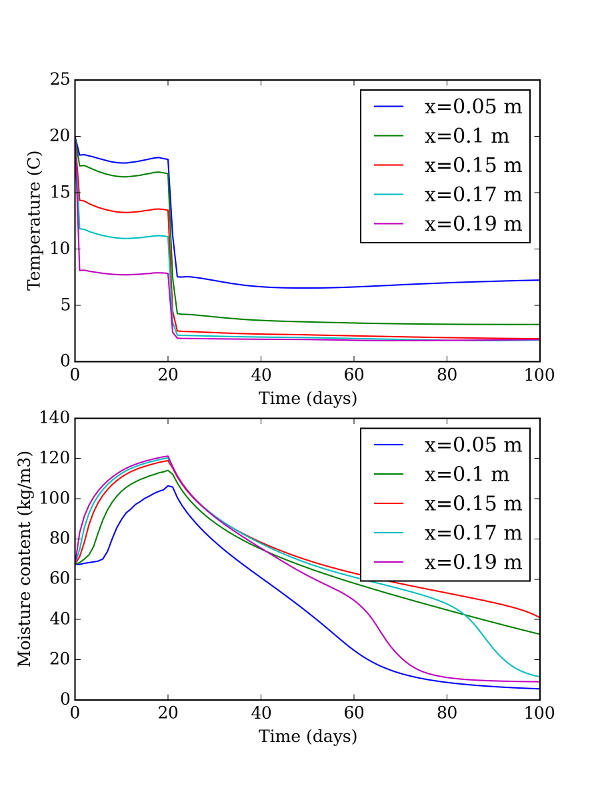
This script simulates the third exercise of the Hamstad benchmark package: transient heat and moisture transfer impacted by air flow through a lightweight wall.
Note that the external air pressure fluctuates on one side of the domain, and that its values are read from a .txt file which has two columns labeled Time (s) and DeltaP. This file is available in the hamopy/benchmarks folder
Script
from hamopy.classes import Mesh, Boundary, Time

# Meshing
from hamopy.materials.hamstad import BM3

mesh = Mesh(**{"materials"    : [BM3],
           "sizes"        : [0.2],
           "nbr_elements" : [40] })

# Boundary conditions
clim_file = 'BM3 climate.txt'

clim1 = Boundary('Fourier',**{"file"      : clim_file,
                          "time"      : "Time (s)",
                          "T"         : 293.15,
                          "HR"        : 0.7,
                          "h_t"       : 10,
                          "h_m"       : 2e-7,
                          "P_air"     : "DeltaP"})

clim2 = Boundary('Fourier',**{"T"         : 275.15,
                          "HR"        : 0.8,
                          "h_t"       : 10,
                          "h_m"       : 7.38e-12 })
clim = [clim1, clim2]

# Initial conditions
init = {'T'  : 293.15,
    'HR' : 0.95}

# Temporal discretisation
time = Time('variable',**{"delta_t"  : 900,
                      "t_max"    : 8640000,
                      "iter_max" : 12,
                      "delta_min": 1e-3,
                      "delta_max": 900 } )

if __name__ == "__main__":

    import numpy  as np
    import pandas as pd

    # Simulation
    from hamopy.algorithm import calcul
    results = calcul(mesh, clim, init, time)

    # Post-processing
    from hamopy.postpro import evolution
    data0 = pd.read_csv(clim_file, delimiter='\t')
    t_out = np.array( data0['Time (s)'] )
    x_out = [0.05, 0.1, 0.15, 0.17, 0.19]

    from hamopy import ham_library as ham

    Temperature     = np.column_stack([evolution(results, 'T', _, t_out) for _ in x_out])
    Humidity        = np.column_stack([evolution(results, 'HR', _, t_out) for _ in x_out])
    MoistureContent = BM3.w(ham.p_c(Humidity, Temperature), Temperature)
    # Plotting results

    import matplotlib.pylab as plt
    from matplotlib import rc
    rc("font", family="serif", size=12)

    figsize(6, 8)

    ax = plt.subplot(211)

    plt.plot(t_plot / (24*3600), Temperature)
    plt.xlabel('Time (days)')
    plt.ylabel('Temperature (C)')
    plt.legend(('x=0.05 m', 'x=0.1 m', 'x=0.15 m', 'x=0.17 m', 'x=0.19 m'))

    ax = plt.subplot(212)

    plt.plot(t_plot / (24*3600), MoistCont)
    plt.xlabel('Time (days)')
    plt.ylabel('Moisture content (kg/m3)')
    plt.legend(('x=0.05 m', 'x=0.1 m', 'x=0.15 m', 'x=0.17 m', 'x=0.19 m'))

    fig = plt.gcf()
    fig.savefig('BM3_results.png', format='png', dpi = 300)
Results